Hernia – Causes, Types, Risks & Laparoscopic Treatment
Dr. Achal Agrawal, Best Laparoscopic Surgeon, Indore, says that a hernia usually happens in your abdomen or groin, when one of your organs pushes through the muscle or tissue that contains it. It may look like an odd bulge that comes and goes during different activities or in different positions.
It may or may not cause symptoms, such as discomfort or pain. Most hernias eventually will need surgical repair.
Hernia occurs when part of your insides bulges through an opening or weakness in the muscle or tissue that contains it. Most hernias involve one of your abdominal organs pushing through one of the walls of your abdominal cavity.
Hernias can occur gradually as you get older and regular wear and tear on your muscles begins to add up. They can also result from an injury, surgery or birth disorder.
Types of Hernia
Some common types of hernia are mentioned below by Hernia Specialist Indore, Dr. Achal Agrawal:
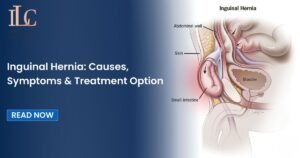
Inguinal Hernia
Mostly affects men. It happens when part of your bowel protrudes into your inguinal canal, a passageway that runs down your inner thigh.
Hiatus Hernia
It happens when the opening in your diaphragm — where your esophagus passes through — widens, and the top of your stomach pushes up through the opening into your chest.
Incisional Hernia
An incisional hernia occurs when tissue protrudes through a former incision in your abdominal wall that weakened over time. It’s a common side effect of abdominal surgery.
Umbilical Hernia
An Umbilical Hernia occurs when part of your intestine pokes through an opening in your abdominal wall near the belly button.
Ventral Hernia
It occurs through the front wall of your abdomen and includes umbilical hernias and incisional hernias.
Risk Factors Contributing to Hernia
Dr. Achal Agrawal, Awarded for excellence in Laparoscopic Surgery in Madhya Pradesh, states some risk factors:
- A job that involves heavy lifting or many hours of standing.
- Chronic cough or allergies that cause chronic sneezing.
- History of abdominal or pelvic surgery.
- Chronic obesity (BMI greater than 30).
- Chronic constipation.
- Straining to poop or pee.
Complications of Hernia
In most cases, complications begin when a hernia gets stuck and can’t move back in (incarceration).
An incarcerated hernia can become increasingly painful and serious. If it’s your bowel that’s stuck, your bowel may develop an obstruction that makes it unable to pass food or gas.
If incarcerated tissue doesn’t have access to blood supply (strangulation), it can lead to tissue death (necrosis or gangrene).
Treatment of Hernia
Only treatment of hernia is surgical repair. Surgery can be open or laparoscopic.
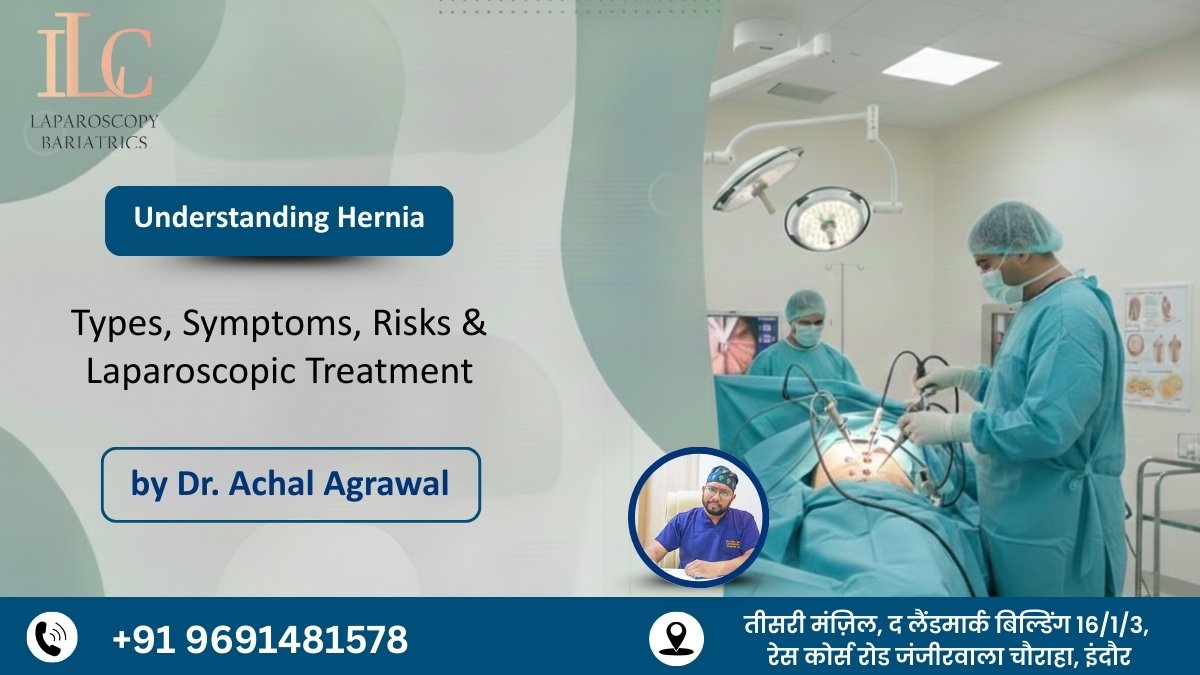
According to Best Laparoscopic Hernia Surgeon of Indore, Dr. Achal Agrawal, laparoscopic surgery uses a laparoscope — a long, thin tube with a lighted camera on the end — to look inside the surgical site. The laparoscope goes in one small hole and long, thin surgical tools go through another.
There are only 3–4 incision holes on the patient’s body which heal quickly within 7–10 days.
Laparoscopic Techniques for Hernia Repair
Dr. Achal Agrawal, Hernia Specialist Indore, explains that the most common laparoscopic techniques for Inguinal Hernia Repair are:
TAPP (Transabdominal Preperitoneal) Repair
The surgeon enters the peritoneal cavity and places a mesh through a peritoneal incision over possible hernia sites.
TEP (Totally Extraperitoneal) Repair
The peritoneal cavity is not entered. Mesh is placed from outside the peritoneum.
This approach is more technically challenging than TAPP but may have fewer complications.
Laparoscopic repair is more technically difficult than open repair, but recovery is faster.