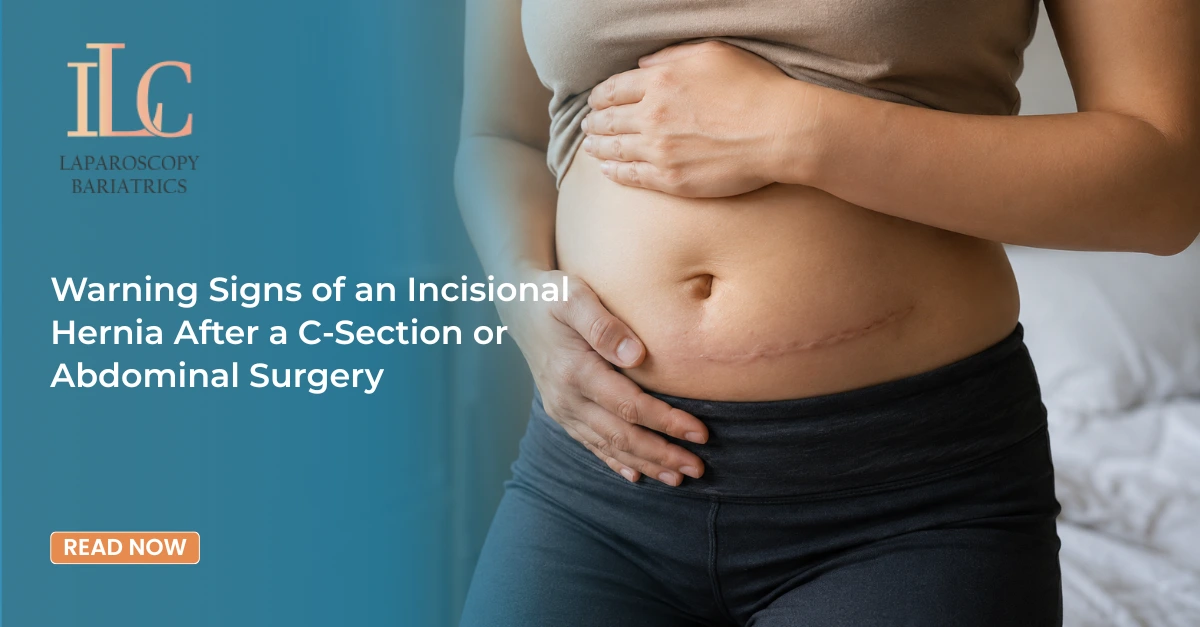
Not every surgical scar heals the way it’s supposed to. In some patients, tissue around the incision stays weaker than it should, and months — sometimes years — later, that weak spot can give way just enough for tissue to push through. That’s an incisional hernia, and it’s more common after C-sections and abdominal surgery than most people realize.
What Is an Incisional Hernia?
It happens when the muscle layer beneath a surgical scar doesn’t fully regain its strength, leaving a gap that internal tissue can push against — sometimes forming a visible bulge. It can appear soon after surgery or take years, which is part of why it’s easy to miss early on.
Who’s More Likely to Develop One?
Certain factors raise the risk, like obesity, diabetes, smoking, a wound infection during initial healing, heavy lifting too soon after surgery, pregnancy following a prior C-section, and generally poor wound healing. None of these guarantee a hernia, but they’re worth knowing if you’ve had abdominal surgery before.
Warning Signs You Shouldn’t Ignore
- A visible lump or bulge near your old surgical scar
- Pain that worsens when standing for long periods
- Discomfort or pain when coughing or straining
- Swelling around the scar that doesn’t settle down
- Digestive issues that seem to come from nowhere
- A bulge that appears to be slowly growing over time
- Ongoing discomfort that doesn’t fully go away with rest
Any one of these on its own might not mean much, but a few showing up together is worth getting checked.
Can It Be Prevented?
Not entirely, but the odds improve with a few habits: avoiding heavy lifting while your incision heals, keeping a healthy weight, managing diabetes well, and actually following your surgeon’s post-op instructions instead of rushing back to normal activity.
How Is It Diagnosed?
Usually starts with a physical exam, and an ultrasound or CT scan can confirm what’s happening beneath the surface if anything’s unclear. A Hernia Specialist In Indore can typically tell fairly quickly whether it’s actually a hernia or something else.
Treatment Options
Depending on size and symptoms, treatment ranges from simple observation for small, symptom-free hernias to surgical repair for larger ones. Laparoscopic Hernia surgery In Indore has become a common approach for many patients, since it typically means smaller incisions and faster recovery than open repair — though the right option depends on your specific case, which is where experienced Laparoscopic Surgeons For Hernia In Indore make the real difference.
When Should You See a Hernia Doctor?
Don’t wait it out if you notice a lump that’s growing, severe or worsening pain, vomiting, redness around the scar, or fever — these can point to a complication that needs prompt attention, not a wait-and-see approach. A Best Hernia Doctor In Indore can evaluate quickly and tell you whether it’s urgent.
FAQs
Can an incisional hernia heal on its own?
No — once the tissue gap forms, it generally needs medical evaluation and, in most cases, surgical repair to fully resolve.
How soon can it appear after surgery?
It varies widely — some appear within weeks, others take years to show up.
Is every scar swelling a hernia?
Not necessarily, but it’s worth getting checked rather than assuming.
Is laparoscopic surgery better?
For many patients, yes, though the right approach depends on hernia size and your individual health picture.
Don’t Ignore It
If you’ve noticed a lump or discomfort near your previous surgical scar, don’t ignore it. Early evaluation by a Hernia Specialist In Indore can help prevent complications and determine whether incisional hernia treatment in Indore is needed.