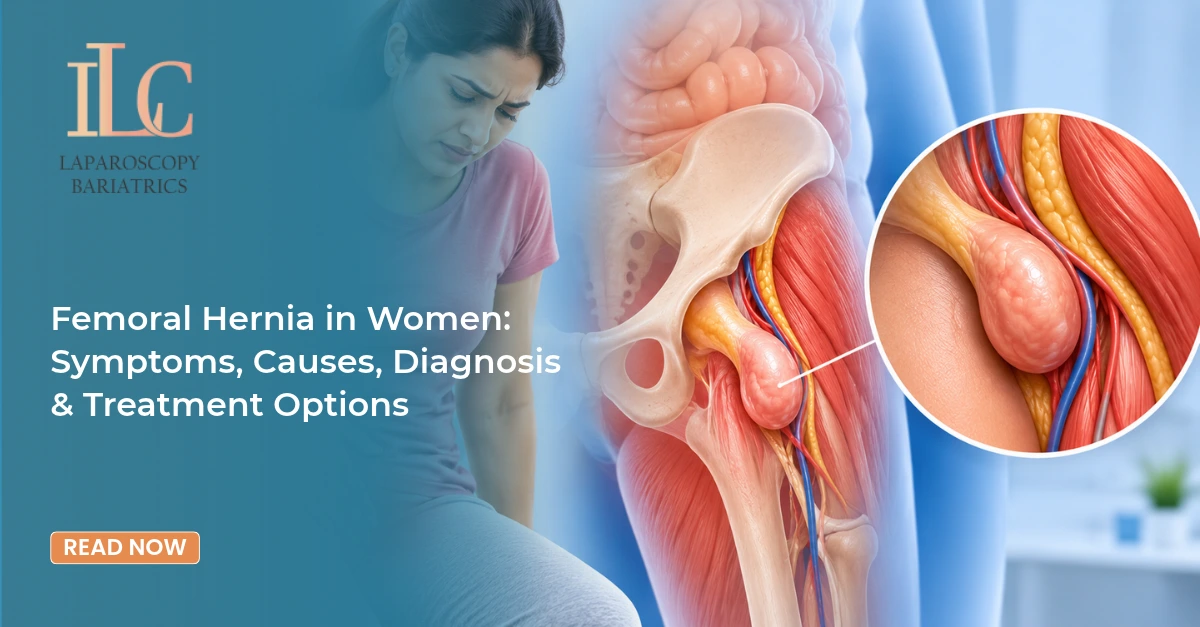
A Femoral Hernia is a small bulge that appears near the top of the thigh, just below the groin. It is much more common in women than in men. Many women ignore it because it looks small and may not hurt. That can be risky because this type of hernia can get stuck and cut off the blood supply. In this blog, we will see the signs, the reasons it happens, how doctors confirm it, and how it is treated.
What Is a Femoral Hernia?
Inside your lower belly, there is a narrow passage where blood vessels travel down to the leg. Sometimes a piece of intestine or fatty tissue pushes through a weak spot there. That push is a femoral hernia. It is often mistaken for an Inguinal Hernia, but it sits slightly lower and is trickier.
Femoral Hernia Symptoms in Women
Some women feel nothing at first. Others notice:
- A small lump in the upper thigh or groin
- A dull ache or pulling feeling, mostly when standing, lifting or coughing
- A lump that gets bigger during the day and shrinks when lying down
Femoral Hernia Causes
The weak spot is often there from birth, and daily strain slowly pushes things through it. Women are affected more because the pelvis is wider.
Common triggers include:
- Pregnancy and childbirth
- Long-term cough
- Constipation and straining
- Being overweight
- Lifting heavy things often
When It Becomes an Emergency
This is the part many people miss. A femoral hernia can get trapped, which doctors call strangulation. Get help straight away if you have sudden severe pain, vomiting, fever, a lump that turns red or dark, or a lump you cannot push back. Do not wait at home.
How Is It Diagnosed?
The doctor first examines you, standing and lying down. If the lump is small or the picture is unclear, an ultrasound is usually done. A CT scan may be advised in some cases. Early diagnosis helps avoid an emergency operation.
Femoral Hernia Treatment
A femoral hernia does not heal on its own, and medicines cannot fix it. Surgery is the proper answer. Because the risk of getting trapped is higher than with many other hernias, doctors usually advise repair even when it is small.
There are two ways to do it. In keyhole surgery, a few tiny cuts are made and the weak spot is closed, often with a mesh for support. In open surgery, one larger cut is made, and this is more common in emergencies. Your surgeon will pick what is safest for you. If you are searching for femoral hernia surgery in Indore, ask the surgeon how many such cases they handle and which method suits your case.
Recovery After Surgery
After keyhole repair, most women generally go home early and return to light work sooner. Open surgery may need a little more rest. Avoid heavy lifting until your surgeon says it is fine. Eat fibre-rich food and drink enough water so you do not strain in the toilet.
Choosing a Femoral Hernia Surgeon in Indore
Look for a surgeon who explains things in simple words and tells you clearly when open surgery is the safer choice. A good femoral Hernia Surgeon In Indore should also tell you what to expect before, during and after surgery.
Consult Dr. Achal Agrawal
Noticed a lump near your groin or thigh? Do not wait for pain. Talk to Dr. Achal Agrawal for a proper check-up and a clear plan. Message us on WhatsApp at 9691481578 or call +91-9691481578.
FAQs
Why are femoral hernias more common in women?
Women have a wider pelvis, which makes the passage in the groin a little more open.
Can a femoral hernia go away on its own?
No. It needs surgery.
Is femoral hernia surgery safe?
Yes, in experienced hands. Planned surgery is much safer than waiting for an emergency.
Can it come back after surgery?
Rarely. A proper repair, often with mesh, keeps the chance low.
Can I get pregnant after hernia repair?
Usually yes, but ask your surgeon about timing for your case.